HR
HR
When a scandal breaks, citizens expect someone to uncover the truth. When public money is spent, we expect someone to ask questions. When institutions fail, we rely on someone to investigate the facts and make them public.
That “someone” is journalists.
They expose corruption, investigate abuses of power, report from wars, earthquakes, and floods, and keep watch over courts, governments, and local communities. Their work shapes democracy and protects citizens’ right to be informed.
Over the past two decades, the media landscape has changed dramatically. Advertising revenues that once sustained newsrooms have shifted to global digital platforms. Newspapers are purchased less frequently, while audiences have become accustomed to accessing content online for free. News is available at the click of a button, yet we often forget that behind every published story lie hours of work: research, fact-checking, interviews, and editorial responsibility. Journalism is not free.
Who pays the journalist who spends months investigating a corruption scandal? Who finances reporting from crisis zones? Who ensures that local communities have independent media capable of monitoring mayors, ministers, and major corporations without depending on them?
While society expects journalism to serve as a guardian of democracy, many journalists work under precarious conditions, for low pay, or without adequate legal protection. Freelancers and those working outside major newsrooms or in local media are particularly vulnerable. There is more content than ever before, yet less money for those who create it.
We want to highlight that behind the articles we read every day, the news we share, and the stories that shape public discourse stand real people—journalists whose work requires time, expertise, experience, and dedication to the public interest. Every published story involves hours of research, interviews, fact-checking, and accountability to the public, often accompanied by personal and safety risks.
At the same time, the media landscape has undergone profound changes. Advertising revenues that once financed newsrooms have migrated to global digital platforms. Newspapers are bought less frequently, and audiences have become accustomed to receiving news online free of charge. Yet we often forget that quality journalism comes at a cost.
How are journalists paid? Who finances investigative journalism that exposes corruption and abuses of power? How can media independence and decent working conditions for those working in the public interest be secured?
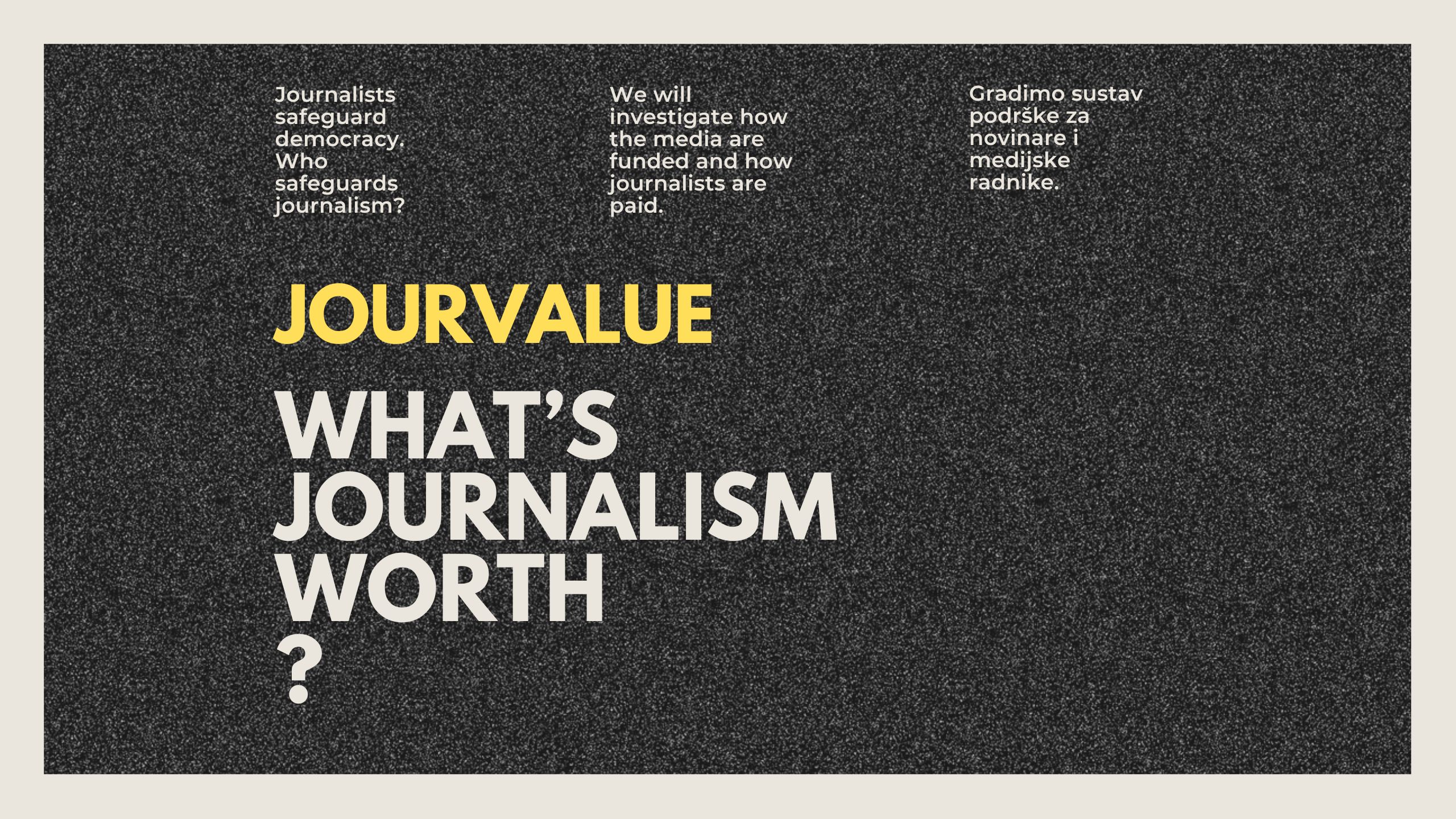
These are precisely the questions behind JOURVALUE: “What Is Journalism Worth?”—a project supported by the European Union.
Over the next two years, together with partners from Croatia, Montenegro, North Macedonia, and across Europe, we will explore how media are financed today, examine the position of journalists, and identify solutions that can ensure a sustainable future for quality and independent journalism.
The project is coordinated by the Trade Union of Croatian Journalists (SNH) and implemented in partnership with the Independent Union of Journalists and Media Workers of North Macedonia (SSNM), the Trade Union of Media of Montenegro (SMCG), and the European Federation of Journalists (EFJ).
JOURVALUE emerged from the shared experience of journalism organisations across the region, all facing similar challenges: declining media revenues, the rise of precarious forms of work, mounting pressures on professional journalism, and increasing difficulties in financing investigative reporting.
Over the next two years, partners will conduct extensive research in Croatia, Montenegro, and North Macedonia to answer several key questions: How are media financed? How are journalists paid? How well protected are freelancers? Which models can ensure sustainable and dignified work in journalism?
Based on the findings, educational programmes will be developed on journalists’ rights, fee negotiations, collective bargaining, content monetisation, freelancer protection, and journalists’ digital and psychological safety.
One of the project’s key outcomes will be the development of a regional digital platform providing journalists and media workers with access to legal tools, contract templates, guides, educational materials, and a network of professional support.
The project will also develop public policy recommendations and alternative funding models for independent and investigative journalism, while raising public awareness about why quality journalism is not a cost, but a public good.
Because democracy cannot function without informed citizens. And there can be no informed citizens without journalists whose work has value and deserves to be fairly compensated.