HR
HR
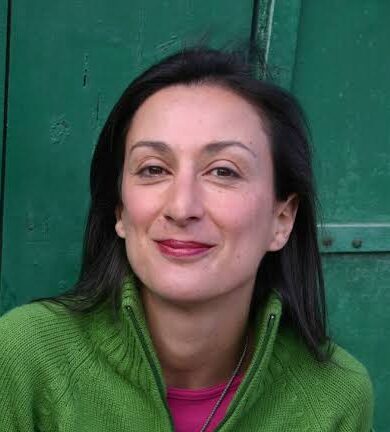
On 16 October 2017, Daphne Caruana Galizia was at her family home in Bidnija, Malta. Her son Matthew was working on his computer.
“I didn’t even notice the time passing. Mum made me lunch. She saw that I hadn’t eaten anything. She made a phone call and left the house. Then she came back. She had forgotten Dad’s chequebook. Her bank account was frozen at the time, so he would sign cheques that she could use. Then she left for the last time,” Matthew Caruana Galizia told the court.
“I was working and listening to music. And shortly after she left the house, I heard a very loud explosion.”
His first thought was that it was a fuel tank. A split second later, he went outside.
“I just felt the blood drain from my body because I sensed that something terrible had happened, even though I didn’t know what,” he told the jurors. He went down the road towards the main road, walking faster and faster until he was running. He saw a tall column of smoke, like “burning tyres.”
“The road was on fire. I saw pieces of metal, then pieces of flesh. I still didn’t understand what was happening. I followed the smoke with my eyes and saw a huge ball of fire in the middle of a field. I ran towards it. The horn just wouldn’t stop sounding.
“I looked through the flames and saw a black shadow inside the car. I thought, ‘That’s my mum.’ I looked around to see if there was anything I could use to open the door. Then I saw a leg on the ground. I thought: it’s over.” In those days, I read about the murder in the media, horrified and saddened by the fate of a woman I had never known. At the time, I could not have imagined how profoundly Daphne would come to affect my own life. Investigations followed, then protests and revelations that led ever closer to people in the immediate circle of power, followed by the political crisis of 2019, the resignations of Prime Minister Joseph Muscat’s chief of staff Keith Schembri and minister Konrad Mizzi, thousands of people taking to the streets of Valletta, and finally Muscat’s departure as prime minister. Across Europe, laws, recommendations, resolutions and mechanisms for the protection of journalists were adopted, many of them shaped by what happened to Daphne. Her name became synonymous with the fight against SLAPPs — serial and malicious lawsuits intended to exhaust journalists, ruin them financially and ultimately silence them. The European anti-SLAPP directive, finally adopted in 2024, is also known as “Daphne’s Law.” The European Parliament also established the Daphne Caruana Galizia Prize for Journalism.
Along the way, I got to know Matthew, and Daphne was no longer simply a horrific murder case you follow, a resolution you read, a law you fight for, or a photograph of a murdered journalist you place alongside a text about impunity. I could not then, and still cannot today, imagine that pain and that unrest that goes on for years, that breathless race for justice in which you do not really have the option of stopping, because stopping means accepting that you may never learn the whole truth about who decided to kill your mother.
I listened to podcasts, read everything I could find, read A Death in Malta by his brother Paul Caruana Galizia, and somehow, along the way, Daphne became part of me. Her photograph hangs in our EFJ office in Brussels. We publish it alongside texts about systemic failures, impunity, SLAPPs and journalists’ safety. Somehow, she is always there beside me — that gaze of a woman who, it seems to me, simply could not have been anything other than honest and brave, who had no choice but to live and work the way she did, because anything else would have meant that she was no longer herself. And she had been subjected to everything we talk about today when we list the dangers journalists face.
For years, she was the target of campaigns of hatred and discrediting. She was insulted and dehumanised, threatened, subjected to attempts to exhaust her financially and buried under lawsuits. At the time of her death, 43 civil and five criminal defamation proceedings were active against her. The economy minister and his associate obtained a court order freezing her assets.
The family home was targeted in arson attacks. Car tyres and fuel canisters were piled against the back of the house and set alight while Daphne and her husband were sleeping inside. They were saved because one of their sons, returning home late, saw the fire. They killed her dog and left it outside the door with its throat cut.
Sometimes I try to imagine that 16 October, precisely because I believe it is a reality I must not look away from, however terrible it may be. I try to imagine Matthew in that house, the explosion he heard, the moment he ran outside, still not knowing — or perhaps already knowing — and that pain that never ends. Sometimes I just want to hug him and talk to him about completely trivial things, about everything that has nothing to do with journalism, Malta, courts, murder or justice. But Matthew was there, and that cannot be erased.
Daphne’s family lost a mother. Her three sons, Matthew, Andrew and Paul, lost the woman who raised them. Her husband Peter lost the woman with whom he had built a life. And that is why it matters to me to keep reminding myself that Daphne was not simply a journalist killed by a car bomb. She was a woman who loved life, her family, food, culture, her garden, her home and her work. And that is precisely why I cannot accept the story in which some criminals planted a bomb, killed Daphne, and then we found them, convicted them, and the case was solved.
Yes, Vincent Muscat admitted his involvement in the murder and was sentenced to 15 years in prison in 2021. Brothers George and Alfred Degiorgio admitted in 2022 that they had participated in the murder and were each sentenced to 40 years in prison. Robert Agius and Jamie Vella, accused of supplying the bomb, were sentenced to life imprisonment in 2025. But who decided that Daphne had to die?
Who ordered her murder?
Who had so much reason to fear one woman and her writing that they were prepared to pay to have her blown up a few hundred metres from her family home?
The Maltese public inquiry, completed in 2021, established something that should never be lost amid all those names, indictments and court proceedings: the state bears responsibility for the circumstances that made Daphne’s murder possible.
The board of inquiry concluded that an atmosphere of impunity had been created at the highest levels of the government of the time, spreading to other institutions, including regulatory bodies and the police, and that the state had failed to recognise the real and immediate risk to Daphne’s life or to take reasonable measures to protect her. It is a horrifying conclusion, but an important one, precisely because it says what is so often erased from stories about murdered journalists: the bomb is not the beginning of the story. It is the end of a long process in which you first declare someone an enemy, then insult them, dehumanise them, target them, sue them, threaten them, allow the mob to attack them, while institutions look the other way — until, at some point, people who are stupid, criminal and unscrupulous enough come to believe that it is entirely possible to solve the problem by killing a woman. And now, almost nine years later, Yorgen Fenech, the businessman whom Maltese prosecutors accused of financing and ordering the murder of Daphne Caruana Galizia, and who was arrested in 2019 while attempting to leave Malta on a yacht, was finally brought before a jury in July this year after years of waiting. On 2 September 2026, he was acquitted, by eight jurors to one.
This means that the people who took part in carrying out the murder and supplying the bomb have been convicted, but almost nine years after Daphne was killed, her family still has no judicially established answer to the question of who ordered her murder.
“The most important thing in my life is justice, and that’s it. My father once told me he was worried about what I was doing. I told him I didn’t care as long as we get justice. Once we get it, I can disappear — nothing else matters to me,” Matthew Caruana Galizia once said.
Matthew and his brothers will continue that breathless race in pursuit of justice, moving the whole world if necessary, in the hope that one day they will see justice done and that it will bring them at least a fragment of peace.
Everything that led to the death of Daphne Caruana Galizia is still here.
The entanglement of criminal interests with politics and money is still here. Institutions that ignore warnings until it is too late are still here. Europe’s powerlessness is still here — a Europe that knows how to write an excellent resolution but finds it much harder to compel a member state to protect a person while they are still alive.
The crowds and mobs that can launch a campaign of hatred against a journalist on social media within hours are still here. Politicians who feed those campaigns are still here. Serial lawsuits against journalists like Daphne are still here, as is the targeting that can so easily turn someone into a target.
Just four months after Daphne, in February 2018, Ján Kuciak and his fiancée Martina Kušnírová were murdered in their home in Slovakia. Ján was 27 years old and had been investigating corruption and links between politics and organised crime.
In that case too, the man prosecutors accused of ordering the murder, Marián Kočner, has still not been finally convicted as the person who ordered the killing.
And every time we talk about Daphne, Ján, Martina and all the other murdered journalists, we must go one step back — to before the bullet and before the bomb.
Because a murder does not begin on the day a journalist is killed.
It begins much earlier, when society accepts that it is perfectly normal to insult someone every day, follow them, intimidate them, bury them in lawsuits and declare them an enemy simply because they are doing their job.
Daphne went through all of it: the hatred, the threats, the SLAPPs, attacks on her home, attacks on her family, political discrediting, institutional indifference and the sense that those who wanted to silence her could get away with almost anything.
And despite all of it, she continued to write because she knew why journalism matters.
In the end, they planted a bomb under her car.
And that is why Daphne’s gaze from the photograph in our Brussels office still follows me.
Not as just another photograph we take out on 16 October, but as the gaze of a woman who was alive, brave, witty, a mother, a wife, a journalist and a person who believed that some things simply have to be written, whatever the cost.
That gaze follows me every time someone downplays a threat against a journalist, every time an institution decides that something is not yet serious enough to warrant action, every time an online mob is dismissed as harmless, every time a journalist is sued, and every time someone says that insults, threats and dehumanisation are simply part of the job.
They are not.
Almost nine years have passed. The people who took part in her murder are in prison, but there is still no judicially established mastermind behind the killing, while Matthew, Andrew, Paul and Peter are still waiting for a full answer to the question of who decided that Daphne Caruana Galizia had to die — and why.
And until that answer exists, this story has no ending.