HR
HR
The dilution of the SLAPP directive at the Council of the European Union came as an unpleasant surprise to numerous professional organizations and trade unions. For this reason, the Union of Croatian Journalists sent an open letter to the Prime Minister of the Republic of Croatia, Andrej Plenković, the Minister of Culture and Media, Nina Koržinek Obuljen, and the Minister of Justice and Administration, Ivan Malenica.
We are publishing the letter in its entirety:
Respectable Prime Minister Plenković, Minister Obuljen Koržinek and Minister Malenica,
at the celebration of Slobodna Dalmacija's birthday, you stated that a new media law was being prepared, and you also announced changes related to the Electronic Media Council.
We take this opportunity to remind you that the European Commission's report on the rule of law warns that: “Council members are appointed by a simple majority vote in parliament for a renewable five-year term. That appointment of a body under the control of the parliamentary majority is still considered a potential threat to the political independence of the regulator."
We believe that the Government's task is primarily to finally ensure the independence of the regulator, and we expect changes in that direction.
In the same report, the European Commission emphasizes that “Strategic Lawsuits Against Public Participation (SLAPP) directed against journalists remain a significant concern. SLAPP continues to pose a significant financial risk to journalists and has a chilling effect on the media. These lawsuits, which often target journalists personally (and not the media company), continue to have a strong impact on the media, threatening the survival of smaller, local media and freelance journalists.
There are still a number of examples of lawsuits against journalists being initiated by politicians or public officials, including judges. "Many SLAPP cases against journalists are based on allegations of defamation, embarrassment, or insult."
Therefore, we are not a little surprised that in the discussion of the Council of the European Union, a representative of the Croatian government and the Ministry of Justice and Administration supported the joint position on the Anti-SLAPP Directive.
With its position, the Council of the EU significantly dilutes the proposal of the European Commission, and the proposal of the Council of the EU falls far short of the original goal of the act: to protect journalists and the right to information in the European Union, and is far below what the European Commission has proposed so far. The Council of the EU, in its view, does not offer an effective and efficient framework to stop SLAPPs because:
- it intends to limit the scope of the directive to pure “cross-border” cases, ie. cases where prosecution takes place in another EU Member State;
- it excludes from the directive’s scope civil claims brought in criminal proceedings;
- it significantly weakens the early dismissal mechanism by proposing a restrictive definition of “manifestly unfounded cases” and by ruling out the possibility to appeal decisions refusing early dismissal;
- it deletes the provision on damage compensation in favour of SLAPP targets.
During the Council meeting, Croatian representatives also supported the Council's position. And they agreed to a "balanced" approach, as well as allowing the necessary "flexibility" at the national level and giving "more discretion to national courts". How this discretion looks in national courts is best evidenced by the large number of SLAPP lawsuits in Croatia, which puts it at the very top of Europe, and often nebulous judgments against journalists.
Support for strong and independent journalism should not only be declarative, we expect the Croatian Government to contribute to strengthening the protection of the free work of journalists at the national and European level, and to support a system that will protect them from SLAPP lawsuits.
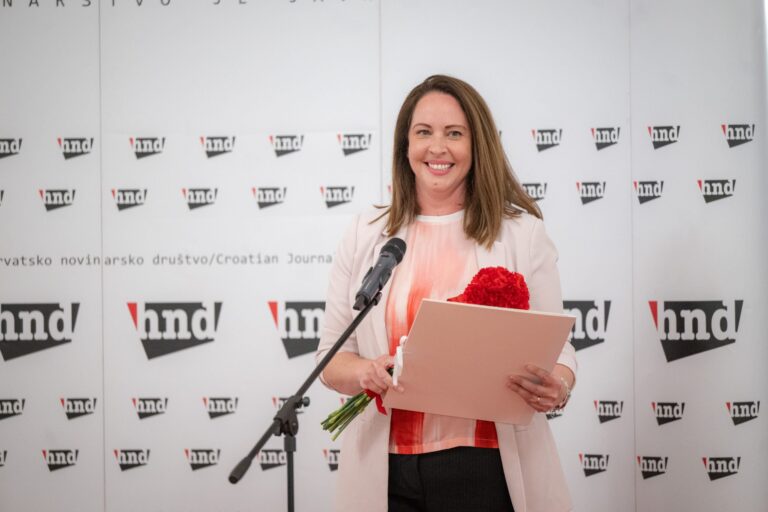
Maja Sever, President of the Trade Union of Croatian Journalists
13. lipnja 2023.
3 Minute čitanja
An open letter to the Prime Minister and ministers on the dilution of the SLAPP directive